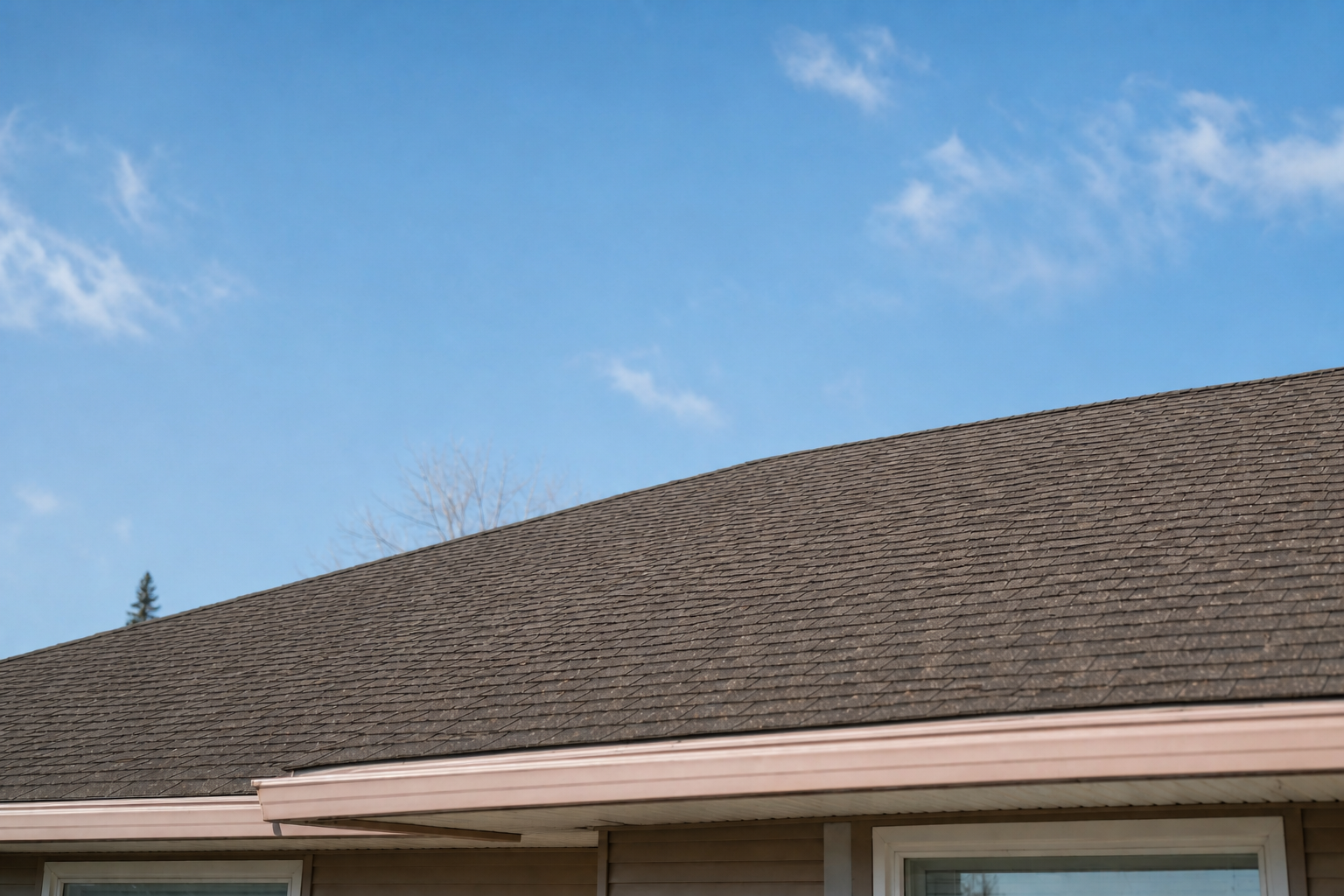
What storms do to Richardson roofs
A spring supercell can drop hail from pea-sized up to golf-ball-sized within minutes, and it does not need to break a shingle to shorten its life. Bruising to the mat under the granules is the more common outcome, and it can sit unnoticed until a leak shows up two summers later.
Straight-line wind out of a squall line lifts the first course at the eaves, peels back shingles whose seal strip has already weakened, and pushes water up under ridge caps. Both kinds of storm move through the Dallas area several times a year, which is why an inspection after any significant event is worth the half hour it takes.
The first day or two
Active leaks are tarped first, before anything else gets looked at. A tarp that is only stapled at the corners does not survive the next front, so battens and screws go down over the edges and the tarp extends past the ridge line. Photos are taken and dated before the tarp goes on, and copies go to the homeowner the same day.
Where a tree limb has come down on the roof, it is removed first and the decking underneath is checked for structural damage before any roofing work starts. A cracked rafter is a framing problem before it is a roofing problem.
The damage assessment
Once the weather has cleared, the whole roof is inspected, not only the section with the obvious problem. Hail damage often shows as bruised granules and soft spots that are easy to miss from the ground, so a slope-by-slope count is done and marked on a simple sketch of the roof.
The assessment separates storm damage from ordinary wear, since that distinction is what determines whether an insurance claim covers the work. A fifteen-year-old roof with a few creased shingles is a different claim from a five-year-old roof with an entire slope bruised by hail.
Working with an insurance claim
The report produced after a storm includes the date of the event, a per-slope damage count, photos with a reference scale, and a repair scope. Adjusters want to know whether the roof is repairable by slope or whether the shingle is discontinued and matching is impossible, since that can move a claim from repair to full replacement.
The homeowner deals directly with the insurance carrier. The role here is to supply accurate documentation and to walk the roof with the adjuster if that is useful.
Permanent repair
Once the decking is dry, permanent repairs follow: lifted shingles are replaced and hand-sealed, bruised slopes are stripped and re-shingled with the full six-nail pattern, and any damaged decking is replaced. Where a whole slope is being redone anyway, ventilation is brought up to a proper standard at the same time.